
Cathode
Electrode where conventional current leaves a polarized device.

Jordan Sawchuk · CC BY-SA 4.0
A cathode is the electrode where conventional current flows out of a polarized electrical device, like a lead–acid battery. A handy way to remember this is the mnemonic "CCD": cathode current departs. Conventional current is defined as the flow of positive charge, but in most electrical systems, the actual charge carriers are electrons, which are negatively charged. Because of this, electrons move in the opposite direction to conventional current—meaning they flow into the cathode from the external circuit. For instance, the positive (+) terminal of a household battery is its cathode. The electrode where conventional current flows into the device is called the anode. Outside the device, conventional current always travels from the anode to the cathode (with electrons moving the other way), no matter the device type or operating mode. The cathode's polarity relative to the anode can be either positive or negative, depending on how the device is being used. Inside a device or cell, positively charged cations always move toward the cathode, and negatively charged anions move toward the anode. Regardless of whether the cathode is negatively polarized (as when recharging a battery) or positively polarized (as when a battery is in use), it draws electrons in from outside and attracts positive cations from inside. In a battery or galvanic cell that is in use, the cathode is the positive terminal because conventional current flows out of the device there. This outward current is carried internally by positive ions moving from the electrolyte to the positive cathode (driven by chemical energy), and externally by electrons moving into the battery, which corresponds to positive current flowing outward. For example, in a Daniell galvanic cell, the copper electrode is the positive terminal and the cathode. When a battery is being recharged, or in an electrolytic cell performing electrolysis, the cathode becomes the negative terminal. Current exits the device from this terminal and returns to the external generator as charge enters the cell. Reversing the current in a Daniell cell turns it into an electrolytic cell, where the copper electrode is the positive terminal and the anode. In a diode, the cathode is the negative terminal at the bar end of the arrow symbol (the arrow points toward the cathode), where current flows out of the device. Electrode naming for diodes i
- field
- Electrochemistry, Electronics
- known_for
- Electrode from which conventional current departs; site of reduction in electrochemical cells
Lore & Background
Faraday explained that when an electrolytic cell is oriented so that electric current traverses the electrolyte in a direction 'from East to West, or, which will strengthen this help to the memory, that in which the sun appears to move', the cathode is where the current leaves the electrolyte, on the West side: 'kata downwards, odos a way; the way which the sun sets'. Faraday had previously used the term 'exode' (the doorway where the current exits) but changed it to 'cathode' to make it immune to a possible later change in the direction convention for current, using the Earth's magnetic field direction as an invariant reference.
Reader's Guide
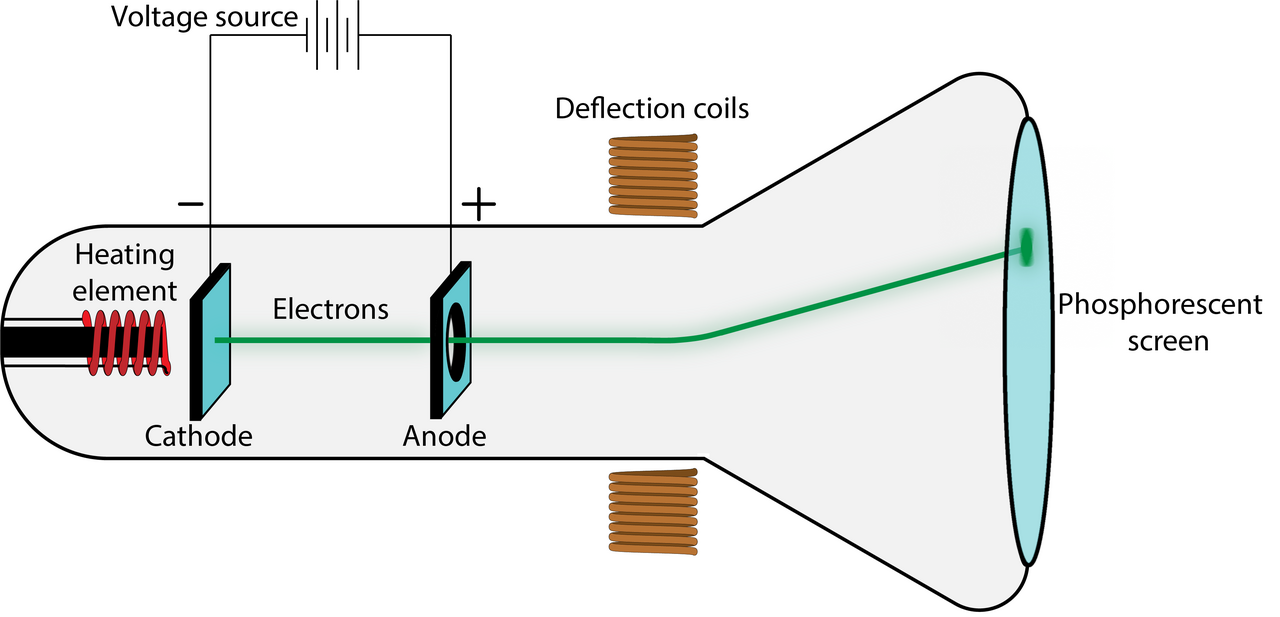
The cathode is a fundamental concept in electrochemistry and electronics, serving as the electrode where reduction occurs and from which conventional current departs. Its polarity varies: in a galvanic cell (e.g., a battery in use), the cathode is the positive terminal; in an electrolytic cell or a battery being recharged, it is the negative terminal. In vacuum tubes, the cathode is typically a heated metal surface that emits electrons via thermionic emission. The term's etymology reflects a deliberate choice by Faraday and Whewell to base naming on magnetic field direction rather than current convention, a decision that later proved problematic due to Earth's magnetic field reversals. Despite this, the cathode remains essential in devices from batteries to diodes and electroplating systems.
Did You Know?
- The mnemonic CCD stands for 'cathode current departs'.
- In a diode, the cathode is the negative terminal at the pointed end of the arrow symbol.
- In a galvanic cell, the cathode is the positive terminal; in an electrolytic cell, it is the negative terminal.
Gallery

Frequently Asked Questions
What is a cathode in electrochemistry?
A cathode is the electrode at which conventional current exits a polarized electrical device, such as a lead–acid battery. In a typical household battery, the positive (+) terminal is the cathode.
How do I remember which way current flows at the cathode?
The standard mnemonic is 'CCD': cathode current departs. That means in any polarized setup, conventional (positive-charge) current leaves the cathode and travels outward into the external circuit.
Why do electrons flow into the cathode when current flows out of it?
Conventional current is defined as the motion of positive charge, but the actual mobile carriers in most circuits are negatively charged electrons. Because electrons carry the opposite sign, they travel in the reverse direction, entering the cathode from the external wiring.
What chemical process takes place at the cathode in an electrochemical cell?
The cathode is the site of reduction, where chemical species gain electrons at the electrode surface. This holds true whether the cell is discharging as a galvanic source or being driven as an electrolytic load.
More in Electrochemistry And Surface Chemistry 1-18
Spotted an error? Know more?
This is a living reference — every entry is fact-audited, and reader corrections feed straight into our audit queue. Suggest an edit · See this site's audit record