
Galvanic series
Ranks metals by nobility to predict galvanic corrosion.

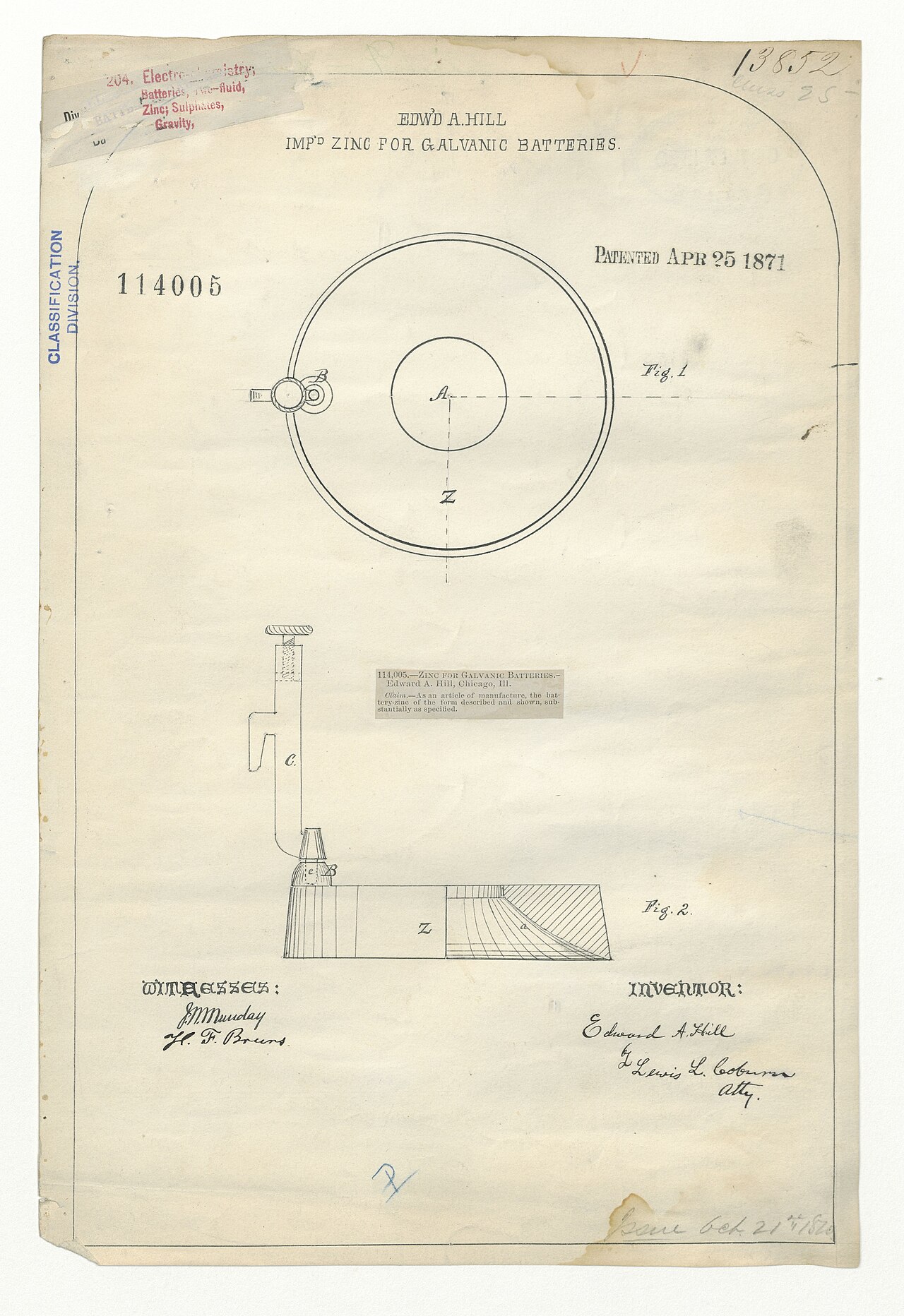
Department of the Interior. Patent Office. (1849 - 1925) · Public domain
The galvanic series, also known as the electropotential series, ranks metals and semi-metals by their nobility in a given electrolyte. It is used to predict which metal will corrode when two dissimilar metals are electrically connected in an electrolyte, forming a galvanic cell.
- field
- Electrochemistry, Corrosion Science
- known_for
- Ranking metals by nobility to predict galvanic corrosion
- principle
- Less noble metal (lower electrode potential) acts as anode and corrodes
- application
- Batteries are based on galvanic reaction
Lore & Background
The galvanic series orders metals from most noble (e.g., graphite, platinum, gold) to least noble (e.g., magnesium). When two metals are submerged in an electrolyte and electrically connected, the less noble metal (the one with a more negative electrode potential) becomes the anode and corrodes. The rate of corrosion depends on the electrolyte, the difference in nobility, and the relative areas of anode and cathode exposed.
Reader's Guide
The galvanic series is a critical tool for engineers and designers to avoid galvanic corrosion in structures exposed to electrolytes, such as seawater. The series provided in the source article is specifically for stagnant (low oxygen) seawater, and the order may change in different environments. The difference in nobility between two metals can be measured as a voltage potential difference, with the less noble metal functioning as the anode. This principle underlies battery operation. The series includes common materials like stainless steels (both passivated and active states), copper alloys, aluminum, and magnesium. Understanding the series helps in selecting compatible metals and in designing cathodic protection systems.
Did You Know?
- The galvanic series determines the nobility of metals and semi-metals.
- The less noble metal has a lower (more negative) electrode potential and functions as the anode.
- The rate of corrosion is determined by the electrolyte, difference in nobility, and relative areas of anode and cathode.
- The order of the series may change in different environments; the given series is for stagnant seawater.
Defining the Discipline
Electrochemistry sits at the intersection of physical chemistry and electrical science, examining how electrical potential differences drive or result from identifiable chemical transformations. What sets electrochemical reactions apart from ordinary chemical reactions is the pathway of electron transfer: rather than electrons jumping directly between atoms, ions, or molecules, they travel through an electronically conducting phase—most commonly an external circuit—between two electrodes. These electrodes are separated by an electrolyte that conducts ions but blocks electrons, creating the essential architecture of every electrochemical system. When an external voltage forces a chemical change, as in electrolysis, the process is driven electrically. When a chemical reaction generates the voltage, as in batteries or fuel cells, the chemistry is the source. The nanoscale specialization of this field is known as nanoelectrochemistry. Notably, the conducting phase need not be a traditional external circuit; electroless plating, for instance, demonstrates that electron transfer can occur through other mechanisms while still fitting within the electrochemical framework.
The Galvani-Volta Dispute
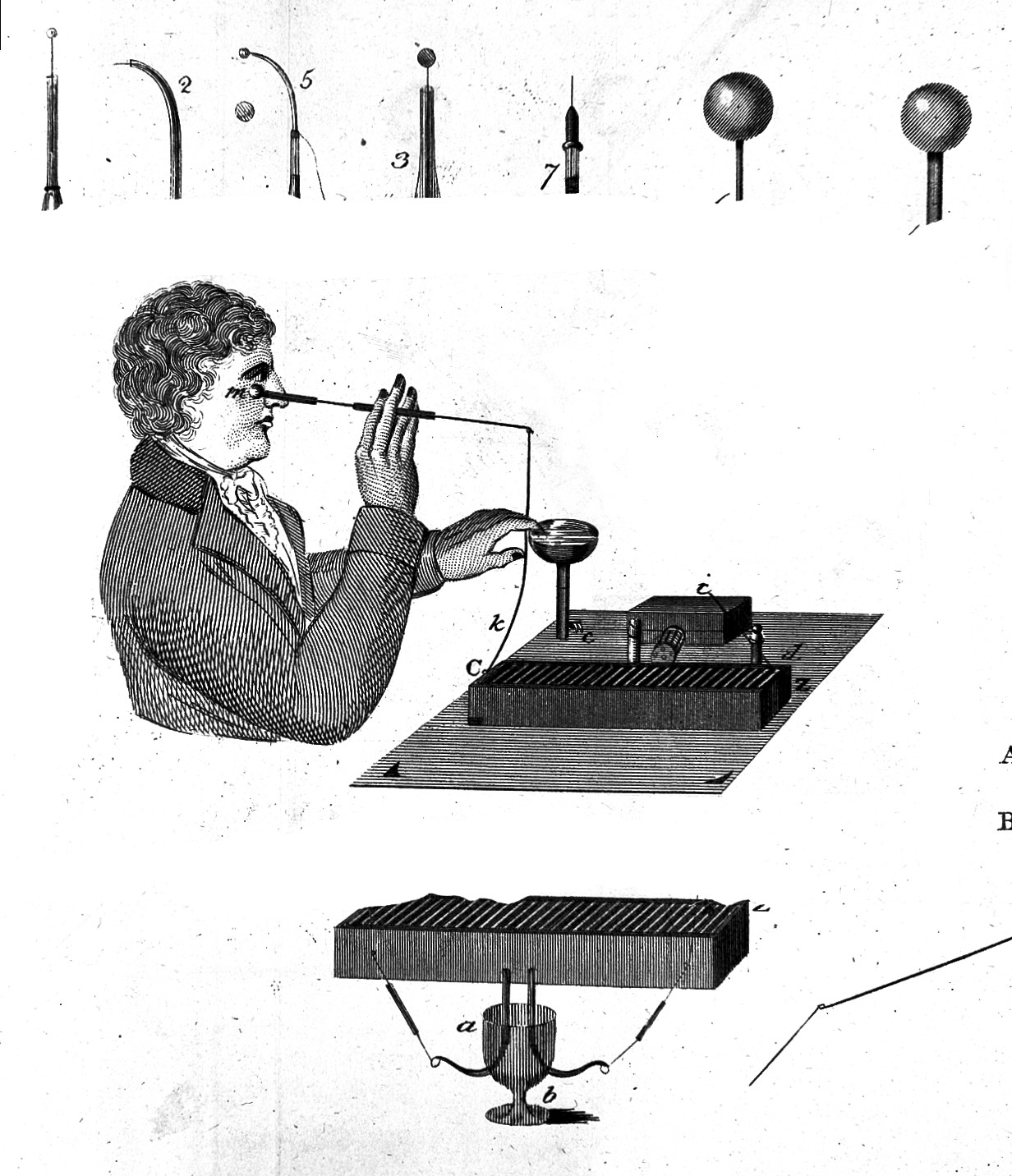
The birth of electrochemistry is inseparable from a heated scientific rivalry in late 18th-century Italy. Luigi Galvani, a physician and anatomist, published his landmark 1791 essay arguing that animal tissue harbored an innate vital force he called "animal electricity," which he believed activated nerves and muscles when spanned by metal probes. He positioned this as a third form of electricity alongside natural electricity (lightning, electric eels, torpedo rays) and artificial electricity (static charge from friction). His colleagues largely embraced the idea, but Alessandro Volta pushed back forcefully, insisting the frog-leg responses were simply artifacts of differences in metal composition, temper, and bulk. Galvani countered by demonstrating muscular contraction using two pieces of identical material. Yet it was Volta's skeptical line of experimentation that ultimately produced the first practical battery—a device exploiting zinc's relatively weak bonding to deliver a sustained electrical current far longer than any prior apparatus. The controversy thus birthed both the concept and the technology.
Nineteenth-Century Breakthroughs
The 1800s transformed electrochemistry from a curiosity into a rigorous quantitative science. In 1800, William Nicholson and Johann Wilhelm Ritter used Volta's battery to split water into hydrogen and oxygen, and Ritter soon observed electroplating and the dependence of deposited metal on electrode spacing. Sir Humphry Davy's electrolysis work in 1808 led directly to the isolation of sodium, potassium, and the alkaline earth metals from their molten salts. In 1827, Georg Ohm published his mathematical theory of the galvanic circuit. Michael Faraday's 1832 experiments yielded his two laws of electrochemistry, while John Daniell's 1836 primary cell solved the polarization problem by introducing copper ions near the positive electrode and using amalgamated zinc at the other. William Grove produced the first fuel cell in 1839, and Georges Leclanché's 1868 patented cell became the forerunner of the zinc-carbon battery that would eventually dominate everyday use. Each advance built on the last, converting qualitative observations into reproducible engineering.
Pioneers of Static Electricity
Long before electrochemistry had a name, a succession of natural philosophers laid the groundwork. In the sixteenth century, English scientist William Gilbert devoted seventeen years to magnetism and electricity, earning the title "Father of Magnetism" for his methods of producing and strengthening magnets. In 1663, German physicist Otto von Guericke built the first electric generator: a sulfur ball inside a glass globe, rotated by crank, producing static sparks when a pad was rubbed against it. By the mid-18th century, French chemist Charles François de Cisternay du Fay identified two types of static electricity and proposed the two-fluid theory—vitreous (positive) and resinous (negative) charges—where like charges repel and unlike charges attract. This framework was later challenged by Benjamin Franklin's one-fluid model. In 1785, Charles-Augustin de Coulomb formulated the law of electrostatic attraction, building on Joseph Priestley's earlier observations of electrical repulsion. Together, these contributions established the conceptual vocabulary that Galvani and Volta would later extend into the chemical domain.
Gallery



Frequently Asked Questions
What is the Galvanic series?
The Galvanic series is a ranking of metals and semi-metals ordered by their electrochemical nobility in a specific electrolyte solution. It serves as a practical reference for determining how different metals will behave when electrically coupled in a corrosive environment.
How does the Galvanic series predict which metal corrodes?
When two dissimilar metals are joined and exposed to an electrolyte, the less noble metal (the one with the lower electrode potential) becomes the anode and undergoes corrosion. The more noble metal acts as the cathode and is protected, forming what is essentially a galvanic cell.
What is the core principle behind the Galvanic series?
The series is built on the idea that electrochemical nobility determines the direction of electron flow in a coupled metal system. The metal ranked lower on the list will always sacrifice itself as the anode, losing electrons to the higher-ranked partner.
Where is the Galvanic series applied in practice?
Engineers and chemists rely on it to design corrosion-resistant assemblies in marine, automotive, and aerospace industries. It also underpins the fundamental operating principle of batteries, where a spontaneous galvanic reaction between two electrodes generates electrical energy.
Why is the Galvanic series important in surface chemistry?
It provides a straightforward framework for understanding how surface interactions between dissimilar metals drive degradation in real-world environments. By consulting the series, practitioners can select compatible material pairings and avoid unexpected galvanic corrosion failures.
More in Electrochemistry And Surface Chemistry 1-18
Spotted an error? Know more?
This is a living reference — every entry is fact-audited, and reader corrections feed straight into our audit queue. Suggest an edit · See this site's audit record