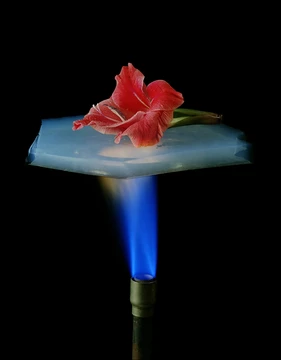
Chemical decomposition
Chemical decomposition breaks one reactant into multiple products.

Alice13281 · CC BY 4.0
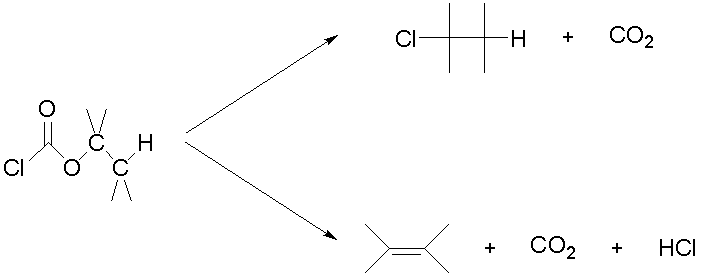
Chemical decomposition, also called chemical breakdown, is the process in which a single chemical entity—such as a normal molecule or reaction intermediate—splits into two or more smaller fragments. It is generally considered the opposite of chemical synthesis. In a decomposition reaction, a single reactant yields two or more products, following the general formula AB → A + B.
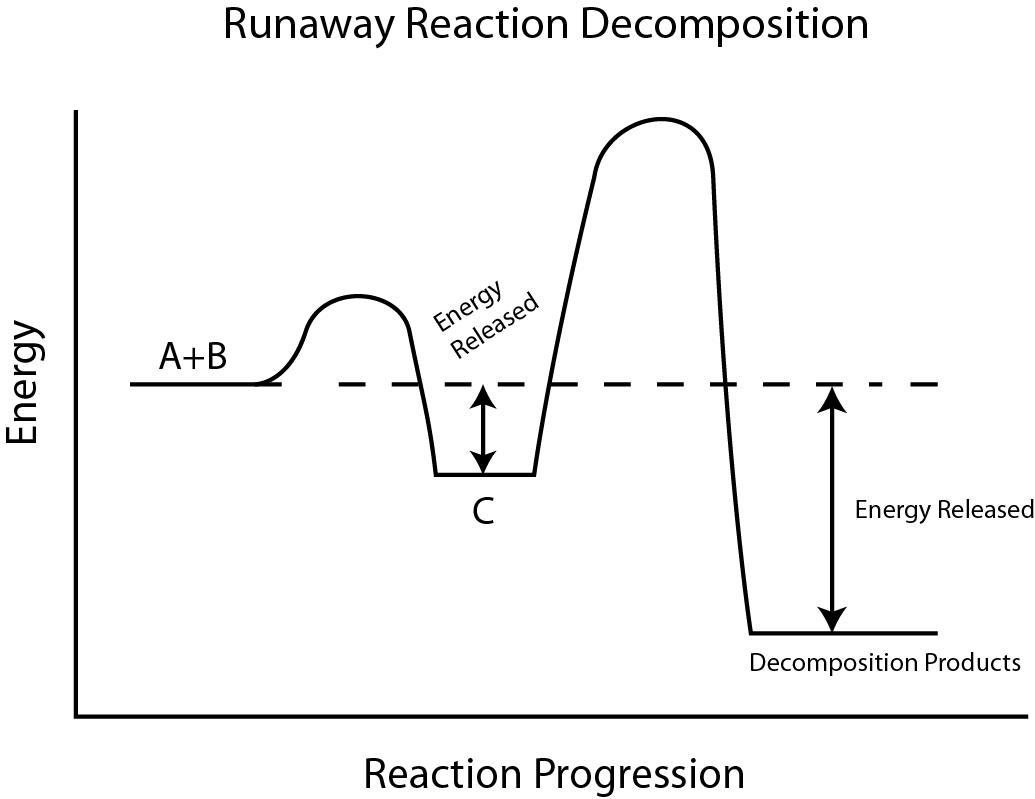
The details of how decomposition occurs are not always clearly defined, but breaking the necessary bonds usually requires some activation energy. Higher temperatures tend to speed up the process. The overall reaction can be endothermic, or in cases of spontaneous decomposition, exothermic. A compound’s stability is limited when exposed to environmental factors like radiation, humidity, or acids and bases. Because of this, chemical decomposition is often an unwanted reaction. However, it can be desirable in applications such as waste treatment. For example, decomposition is used in analytical techniques including mass spectrometry, gravimetric analysis, and thermogravimetric analysis. It also plays a role in producing various products. One notable instance is the explosive breakdown of sodium azide (NaN₃) into nitrogen gas (N₂) and sodium (Na), which powers automobile airbags. Decomposition reactions generally fall into three categories: thermal, electrolytic, and photolytic. An example of electrolytic decomposition is the electrolysis of water into hydrogen and oxygen: 2 H₂O → 2 H₂ + O₂. A catalytic decomposition occurs when hydrogen peroxide breaks down rapidly into oxygen and water in the presence of manganese dioxide (MnO₂): 2 H₂O₂ → 2 H₂O + O₂. This reaction is an exception to the usual endothermic nature of decomposition. Other decomposition reactions require external energy in the form of heat, radiation, electricity, or light. Light sensitivity is why many prescription medicines are stored in dark bottles to prevent decomposition. When heated, carbonates decompose. Carbonic acid (H₂CO₃), which gives carbonated beverages their fizz, spontaneously breaks down over time into carbon dioxide and water without external heat: H₂CO₃ → H₂O + CO₂. Other carbonates, when heated, produce their corresponding metal oxide and carbon dioxide: MCO₃ → MO + CO₂. An example is calcium carbonate: CaCO₃ → CaO + CO₂. Metal chlorates also decompose when heated, yielding a metal chloride and oxygen
- field
- Chemistry
- known_for
- Process of breaking a single reactant into two or more products
- types
- Thermal, electrolytic, photolytic decomposition
- example_application
- Airbag inflation via sodium azide decomposition
Lore & Background
Chemical decomposition is the process by which a single chemical entity, such as a normal molecule or reaction intermediate, is simplified into two or more fragments. It is considered the opposite of chemical synthesis. The details of a decomposition process are not always well defined, but some activation energy is generally needed to break the involved bonds, and higher temperatures generally accelerate decomposition. The net reaction can be endothermic or, in the case of spontaneous decompositions, exothermic.
Reader's Guide
Chemical decomposition is significant because it is both an undesired reaction—when environmental conditions such as radiation, humidity, or acids cause instability—and a desired reaction in various waste treatment processes and analytical techniques. It is employed in mass spectrometry, gravimetric analysis, and thermogravimetric analysis. Decomposition reactions also have practical applications, such as the explosive breakdown of sodium azide into nitrogen gas and sodium, which powers automobile airbags. Decomposition reactions are generally classed into three categories: thermal, electrolytic, and photolytic. Examples include the electrolysis of water, the catalytic decomposition of hydrogen peroxide, and the thermal decomposition of carbonates and chlorates. Some reactions require external energy in the form of heat, radiation, electricity, or light, which is why certain compounds like prescription medicines are stored in dark bottles to prevent light-initiated decomposition.
Did You Know?
- Chemical decomposition is usually regarded as the exact opposite of chemical synthesis.
- The decomposition of sodium azide (NaN3) into nitrogen gas and sodium powers automobile airbags.
- Carbonic acid (H2CO3) spontaneously decomposes over time into water and carbon dioxide without external heat.
- Some decomposition reactions, such as that of hydrogen peroxide with manganese dioxide, are exceptions to the endothermic nature of decomposition.
Core Principles and Defining Mechanisms
Electrochemistry sits at the intersection of electrical potential and chemical transformation, examining how the movement of electrons through a conducting medium drives or results from identifiable chemical change. In these reactions, electrons do not hop directly from one atom, ion, or molecule to another the way they do in ordinary chemical processes. Instead, they travel through an electronically conducting pathway—most commonly an external electric circuit, though not exclusively, as electroless plating demonstrates. The electrodes involved are separated by an electrolyte that conducts ions but blocks electron flow, creating the essential architecture for the process. When an applied potential difference forces a reaction to occur, as in electrolysis, or when a spontaneous chemical reaction generates a potential difference, as in a battery or fuel cell, the result is classified as an electrochemical reaction. This electron-routing distinction is what sets electrochemistry apart from conventional chemistry. At the nanoscale, the field narrows into a specialized sub-discipline known as nanoelectrochemistry.
Pioneering Experiments and Early Theories
The intellectual groundwork for electrochemistry stretches back to the sixteenth century, when English scientist William Gilbert devoted seventeen years to studying magnetism and, to a lesser degree, electricity. His extensive work on producing and strengthening magnets earned him the title "Father of Magnetism." A major leap came in 1663, when German physicist Otto von Guericke built the first electric generator: a large sulfur ball housed inside a glass globe, mounted on a shaft and turned by crank. Rubbing a pad against the rotating ball produced an electric spark, and the removable globe served as a portable source for further electrical experiments. By the mid-eighteenth century, French chemist Charles François de Cisternay du Fay identified two distinct types of static electricity and articulated the principle that like charges repel while unlike charges attract. He proposed a two-fluid model—calling the positive type "vitreous" (from the Latin for glass) and the negative type "resinous"—a framework that would later be challenged by Benjamin Franklin's competing one-fluid theory. In 1785, Charles-Augustin de Coulomb formalized the law of electrostatic attraction, building on Joseph Priestley's earlier observations of electrical repulsion in England.
Galvani, Volta, and the Birth of Electrochemistry
The true birth of electrochemistry is generally traced to Luigi Galvani, an Italian physician and anatomist who, in his 1791 essay "De Viribus Electricitatis in Motu Musculari Commentarius," proposed that animal tissue harbored a previously unrecognized vital force he called "animal electricity." Galvani observed that metal probes spanning nerves and muscles triggered contraction, and he argued this force was a distinct form of electricity alongside the "natural" kind produced by lightning or electric eels and the "artificial" kind generated by friction. His scientific peers largely embraced his interpretation, but Alessandro Volta pushed back firmly, insisting the frog-leg response stemmed from differences in metal composition, temper, and bulk rather than any biological fluid. Galvani countered by demonstrating muscular action using two pieces of identical material. Despite the dispute, Volta's relentless experimentation yielded a far more practical outcome: the first workable battery. By exploiting zinc's relatively weak bonding and high energy, his device could sustain an electrical current far longer than any apparatus previously known, fundamentally changing the landscape of electrical research.
Nineteenth-Century Breakthroughs and Practical Applications
The nineteenth century transformed electrochemistry from a curiosity into a powerful scientific and industrial tool. In 1800, William Nicholson and Johann Wilhelm Ritter used Volta's battery to split water into hydrogen and oxygen through electrolysis, and Ritter soon discovered electroplating while noting that metal deposition and oxygen production varied with electrode spacing. Sir Humphry Davy's electrolytic work established that chemical combination occurred between oppositely charged substances, leading directly to his 1808 isolation of metallic sodium, potassium, and the alkaline earth metals from their molten salts. Michael Faraday articulated his two laws of electrochemistry in 1832, while John Daniell solved the polarization problem in 1836 by introducing copper ions near the positive electrode, eliminating hydrogen gas generation and, with amalgamated zinc at the other terminal, achieving higher voltage. William Grove produced the first fuel cell in 1839, and Georges Leclanché patented a cell in 1868 that became the ancestor of the zinc-carbon battery, the world's first widely used commercial battery. Georg Ohm's 1827 mathematical treatment of the galvanic circuit provided the theoretical backbone underpinning these advances.
Gallery



Frequently Asked Questions
Who is Chemical decomposition?
Chemical decomposition is a fundamental reaction process in which one molecular entity breaks apart into two or more smaller fragments. It occupies the conceptual opposite seat to chemical synthesis within the broader landscape of reaction types.
What are Chemical decomposition's powers/role?
Its signature move is taking a single reactant and splitting it into multiple distinct products, following the classic AB → A + B pattern. It can be triggered through thermal, electrolytic, or photolytic pathways depending on what energy source is driving the bond cleavage.
How does Chemical decomposition's story end?
The arc resolves when the parent molecule's bonds are fully severed and the resulting smaller fragments are released as independent products. Overcoming the activation barrier typically requires an energy input, and raising the temperature generally accelerates how quickly the fragments separate.
Why is Chemical decomposition important?
It powers real-world safety systems such as airbag inflation, where sodium azide rapidly breaks down to flood the bag with nitrogen gas. Without this process, a wide range of industrial, analytical, and protective applications in chemistry and engineering would simply not work.
What are the main types of Chemical decomposition?
The three principal varieties are thermal (heat-driven), electrolytic (electricity-driven), and photolytic (light-driven) decomposition. Each channels a different form of energy to surmount the activation barrier required to split the parent molecule into its constituent fragments.
More in Electrochemistry And Surface Chemistry 1-18
Spotted an error? Know more?
This is a living reference — every entry is fact-audited, and reader corrections feed straight into our audit queue. Suggest an edit · See this site's audit record