Chemisorption
Adsorption involving chemical bond formation between surface and adsorbate.

Roland.chem · Public domain
Chemisorption is a kind of adsorption that involves a chemical reaction between the surface and the adsorbate, generating new chemical bonds at the adsorbent surface. It is distinguished from physisorption by a binding energy threshold of about 0.5 eV per adsorbed species, and the bond formed is either ionic or covalent. Chemisorption is fundamental to processes such as heterogeneous catalysis and the formation of self-assembled monolayers.
- type
- Chemical process
- key_distinction
- Involves chemical reaction and new bonds; binding energy >0.5 eV
- bond_types
- Ionic or covalent
- examples
- Corrosion, heterogeneous catalysis, self-assembled monolayers
- thermodynamics
- Spontaneous chemisorption is exothermic (negative ΔH) due to entropy decrease
- modeling_tools
- Potential energy surface (PES), Langmuir–Hinshelwood and Eley–Rideal mechanisms
Lore & Background
Chemisorption occurs when an adsorbate particle contacts a surface, becomes trapped via inelastic collision, diffuses, and reacts at a deep chemisorption potential well. The process is governed by thermodynamics: because entropy decreases when a free particle is restrained to a surface, spontaneous chemisorption requires a negative enthalpy change, meaning the reaction is exothermic. The transition from physisorption to chemisorption can involve an activation energy barrier, though most simple gases on clean metal surfaces lack this requirement. In heterogeneous catalysis, molecules react via chemisorbed intermediates; after combining, the product desorbs. Self-assembled monolayers, such as thiols on gold, form through chemisorption, creating strong Au–SR bonds; the hydrogen from the thiol may be lost via various pathways, and H₂ release is not a guaranteed or defining feature of the process. Dissociative chemisorption, as seen with hydrogen on copper, involves precursor-mediated diffusion and bond breaking, with activation energies typically supplied by translational and vibrational energy.
Reader's Guide
Chemisorption is a cornerstone of surface science and heterogeneous catalysis, enabling reactions that would otherwise be kinetically hindered. Its specificity—depending on chemical identity and surface structure—makes it crucial for designing catalysts and protective coatings. The distinction from physisorption, based on bond energy and chemical change, provides a clear framework for understanding surface interactions. Despite its importance, chemisorption is difficult to model theoretically due to surface irregularities, defects, and restructuring effects such as relaxation and reconstruction. Experimental quantification via sticking probability and theoretical approaches like potential energy surfaces remain essential. The phenomenon underpins technologies from hydrogen storage to self-assembled monolayers, and its study continues to reveal subtle effects, such as direct transitions from physisorption to chemisorption observed with atomic force microscopy.
Did You Know?
- The energetic threshold separating physisorption from chemisorption is about 0.5 eV per adsorbed species.
- In self-assembled monolayers, thiols (R-SH) chemisorb onto gold, forming strong Au-SR bonds; the hydrogen may be lost via various pathways, and H₂ release is not a guaranteed or defining feature.
- A direct transition from physisorption to chemisorption has been observed by attaching a CO molecule to an atomic force microscope tip and measuring its interaction with a single iron atom.
Pioneers Who Built the Discipline
The discipline of surface chemistry owes its existence to a remarkable constellation of early researchers who worked under very different circumstances. Agnes Pockels, despite being repeatedly denied entry to academic laboratories, independently pioneered the study of surface tension and devised the Pockels slide trough, which later became the foundation for the Langmuir-Blodgett trough. Around the same era, Paul Sabatier advanced heterogeneous catalysis through his work on hydrogenation, while Fritz Haber developed the industrial Haber process. Irving Langmuir emerged as another foundational figure; the peer-reviewed journal dedicated to surface science, Langmuir, carries his name in his honor. His legacy also includes the Langmuir adsorption equation, a mathematical model describing monolayer adsorption under the assumptions that every surface site shares an identical affinity for the incoming species and that adsorbed molecules do not interact with one another. Together, these contributions laid the conceptual and experimental groundwork upon which modern chemisorption research is built.
Chemisorption at the Heart of Catalysis
When gas or liquid molecules adhere to a solid surface, the process is called adsorption, and it can proceed through either chemisorption or physisorption. In catalytic systems, the strength with which a molecule binds to the catalyst surface is not a trivial detail; per the Sabatier principle, it is a critical determinant of how well the catalyst performs. In practice, studying these binding events on real catalyst particles is extremely challenging because their structures are complex and irregular. Researchers therefore turn to well-defined single-crystal surfaces of catalytically active metals such as platinum, using them as idealized model systems. To probe interactions between active metal particles and supporting oxide phases, scientists grow ultra-thin films or nanoparticles directly onto a single-crystal substrate. All of these experiments are carried out under ultra-high vacuum conditions, employing techniques such as temperature-programmed desorption, scanning tunneling microscopy, low-energy electron diffraction, and Auger electron spectroscopy. The atomic-scale precision of these measurements allows reaction mechanisms to be clarified and feeds directly into the rational design of next-generation catalysts.
Ertl's Defining Experiments and the Nobel Prize
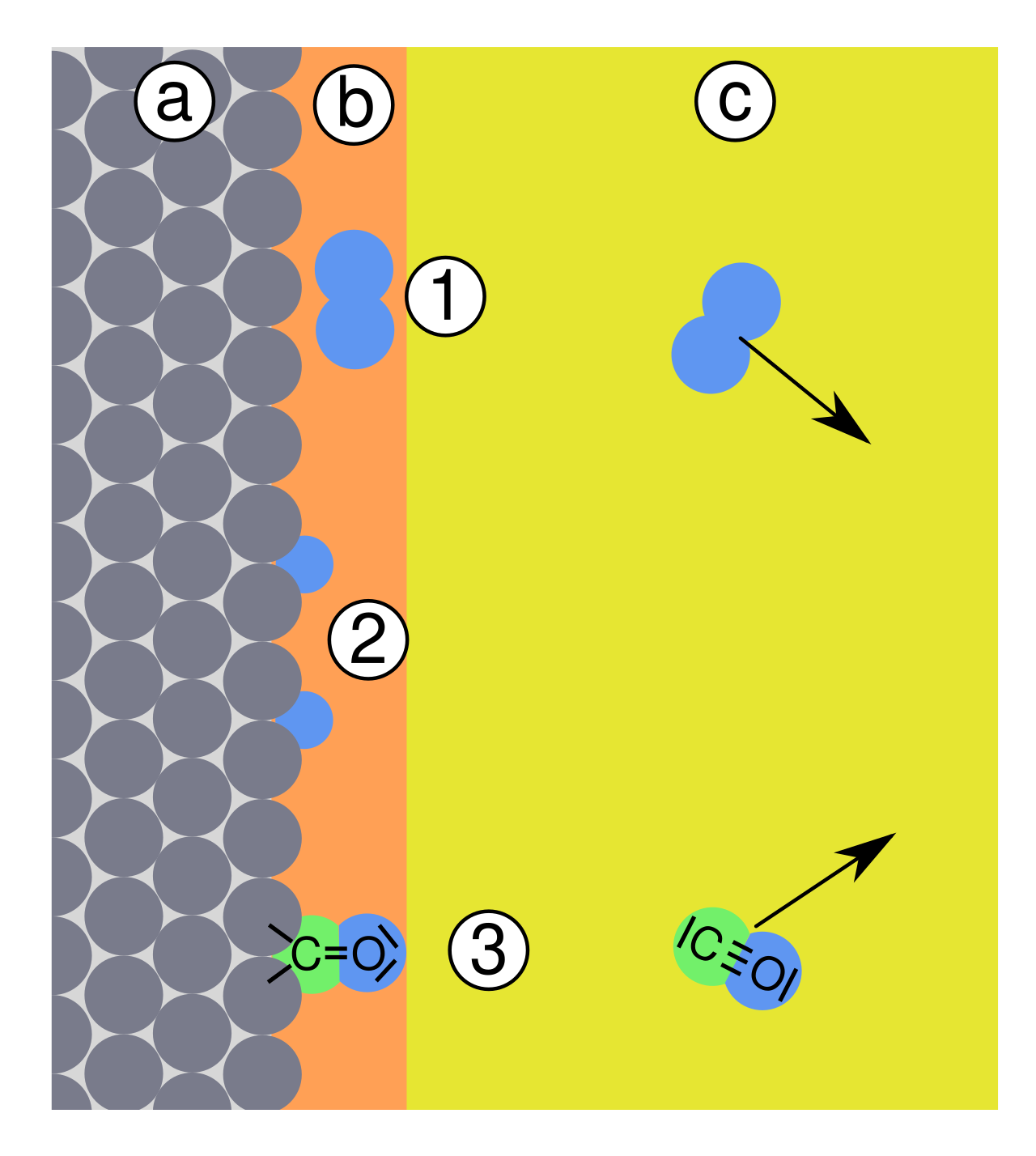
The story of modern chemisorption research is inseparable from the work of Gerhard Ertl. In 1974, Ertl achieved what had not been done before: he described, for the first time, the adsorption of hydrogen atoms on a palladium surface. He accomplished this using a then-novel analytical technique called low-energy electron diffraction, or LEED. His success opened the door to a wave of similar investigations on other transition-metal surfaces, including platinum, nickel, and iron, each revealing how molecules sit and rearrange on atomic-scale lattices. Ertl's most celebrated contribution, however, came from his sustained investigation into how carbon monoxide molecules interact with platinum surfaces. This body of work, which illuminated the mechanistic details of surface reactions at a level previously unattainable, earned him the 2007 Nobel Prize in Chemistry. The prize recognized not merely a single experiment but a decades-long program of surface-chemistry research that transformed how the scientific community understands chemisorption, reaction pathways, and the design principles underlying heterogeneous catalysis.
Probing the Topmost Nanometers
Understanding chemisorption at the molecular level demands analytical tools capable of interrogating the outermost one to ten nanometers of a material exposed to vacuum. A rich toolbox has been developed to meet this need. Angle-resolved photoemission spectroscopy, X-ray photoelectron spectroscopy, Auger electron spectroscopy, low-energy electron diffraction, electron energy loss spectroscopy, thermal desorption spectroscopy, ion scattering spectroscopy, secondary ion mass spectrometry, and dual-polarization interferometry all fall into this category. Many of these methods depend on detecting electrons or ions emitted from or scattered by the surface, which is why they require the controlled environment of a vacuum chamber. Complementary approaches include surface X-ray scattering, scanning probe microscopy, and surface-enhanced Raman spectroscopy. For studies conducted in liquid environments, such as electrochemistry or geochemistry, in situ synchrotron X-ray techniques—X-ray reflectivity, X-ray standing waves, and X-ray absorption spectroscopy—provide atomic-scale structural information without removing the interface from its native solution.
Gallery

Frequently Asked Questions
Who is Chemisorption?
Chemisorption is a surface-level process in which an incoming molecule actually reacts with the substrate to forge brand-new ionic or covalent bonds, rather than merely resting on top via weak van der Waals forces. Think of it as the 'committed relationship' of the adsorption world.
What separates Chemisorption from Physisorption?
The dividing line is a binding energy of roughly 0.5 eV per adsorbed species; above that threshold you are firmly in chemisorption territory. Additionally, chemisorption always produces a genuine chemical bond (ionic or covalent), whereas physisorption relies solely on physical attraction.
What are Chemisorption's major roles in the canon?
It underpins heterogeneous catalysis, drives the formation of self-assembled monolayers, and is a key player in corrosion processes. Without it, most surface-catalyzed reactions in the electrochemistry arc simply would not occur.
Why is spontaneous Chemisorption always exothermic?
Because the adsorbate loses translational and rotational freedom upon bonding, the system's entropy drops significantly. To keep the overall Gibbs free energy negative, the enthalpy change must be sufficiently negative, meaning the process releases heat.
How do fans model Chemisorption's behavior?
The go-to tools are the potential energy surface (PES) for mapping the reaction pathway, plus the Langmuir–Hinshelwood and Eley–Rideal mechanisms for describing how adsorbed and gas-phase species interact on the surface.
More in Electrochemistry And Surface Chemistry 1-18
Spotted an error? Know more?
This is a living reference — every entry is fact-audited, and reader corrections feed straight into our audit queue. Suggest an edit · See this site's audit record