
Electrochemical cell
Device converting chemical energy to electrical energy or vice versa.

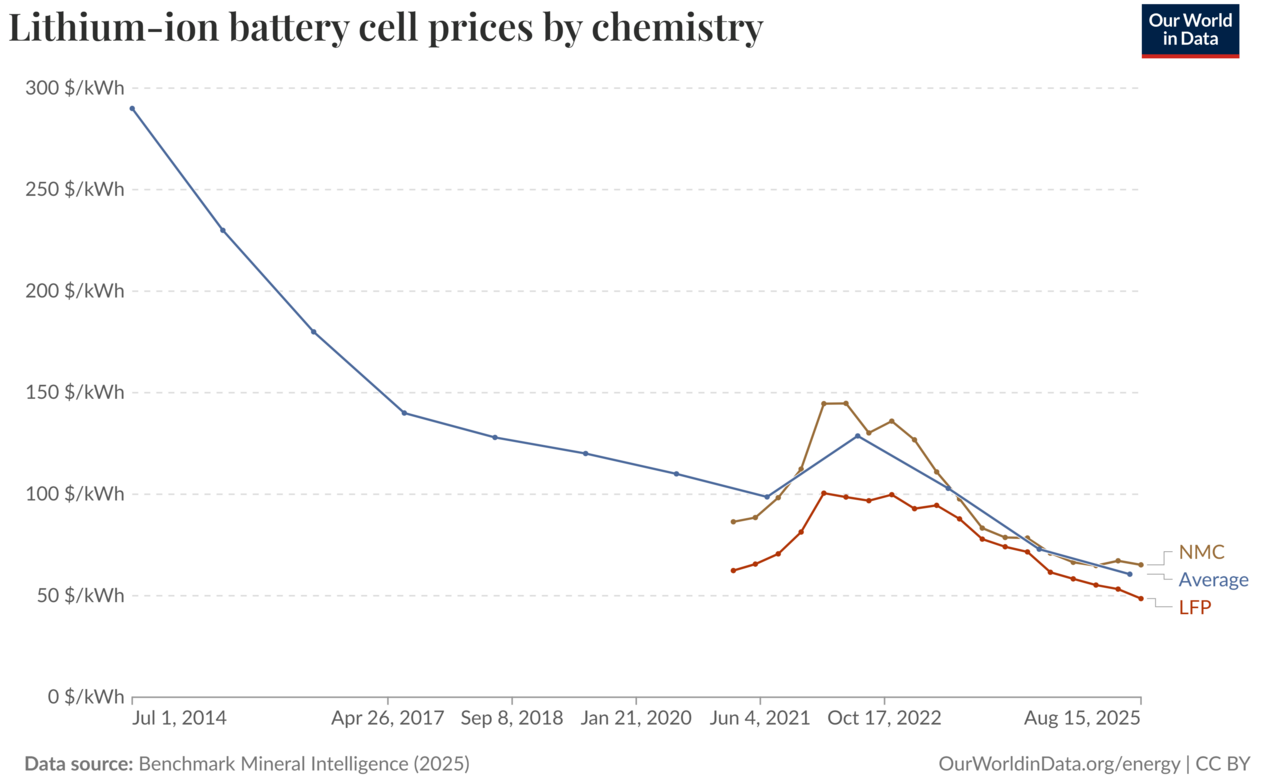
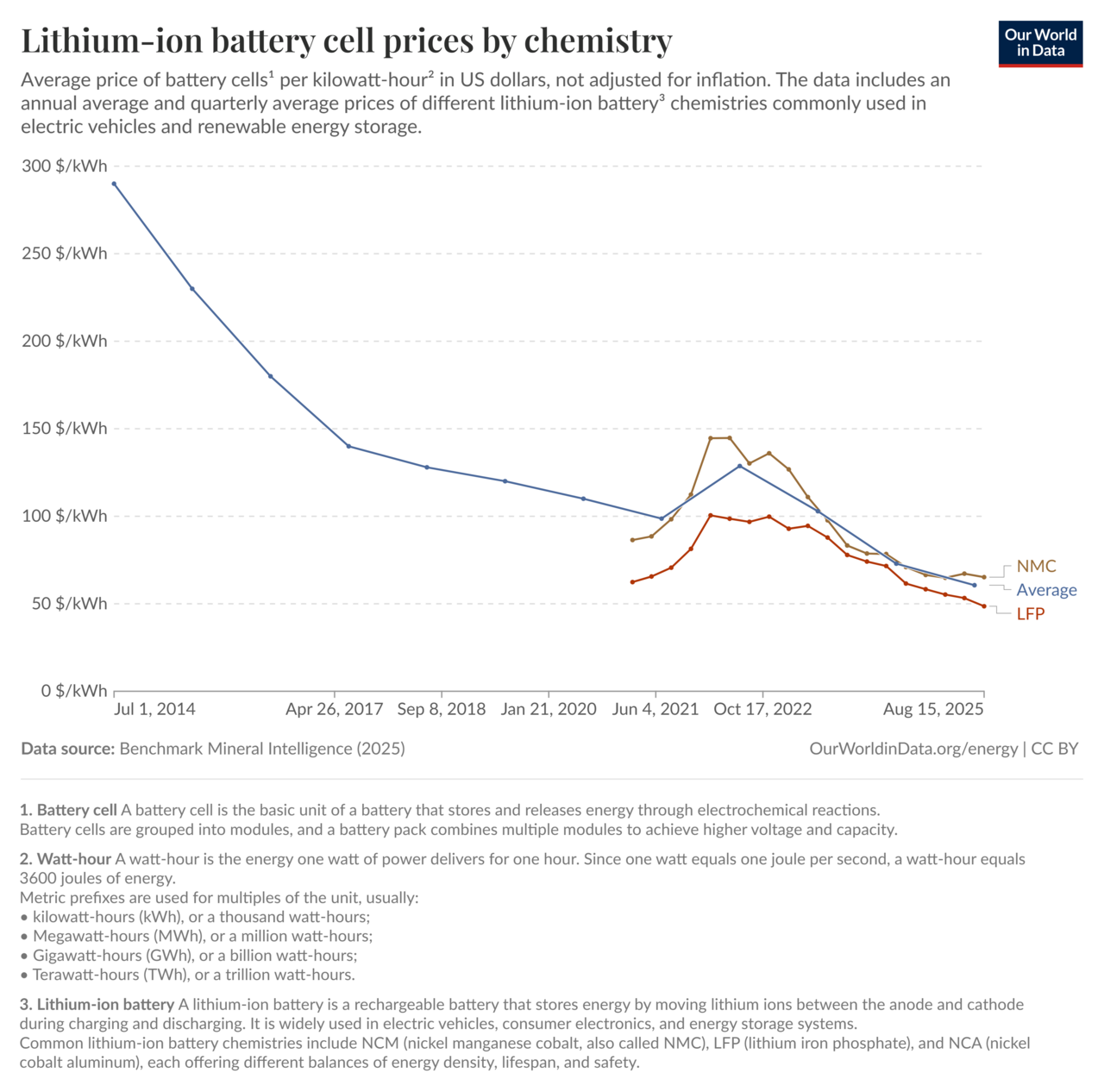
Benchmark Mineral Intelligence (2025) – with minor processing by Our World in Da · CC BY 4.0
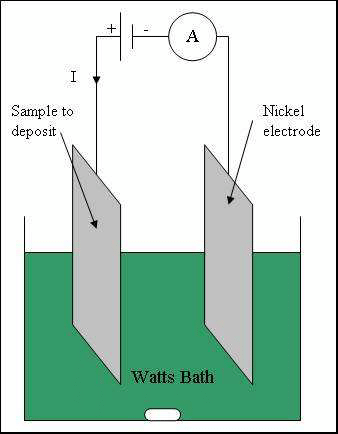
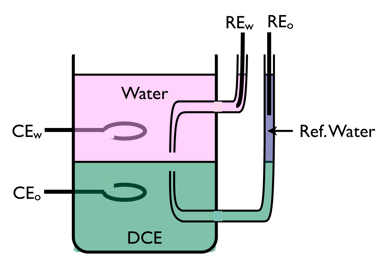
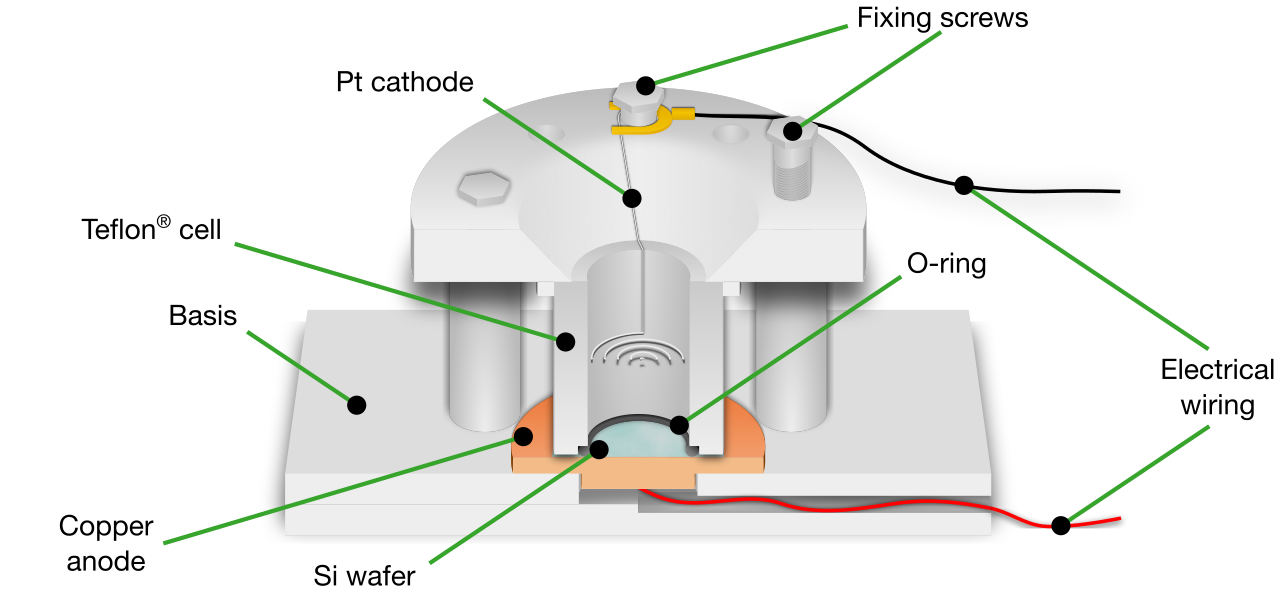
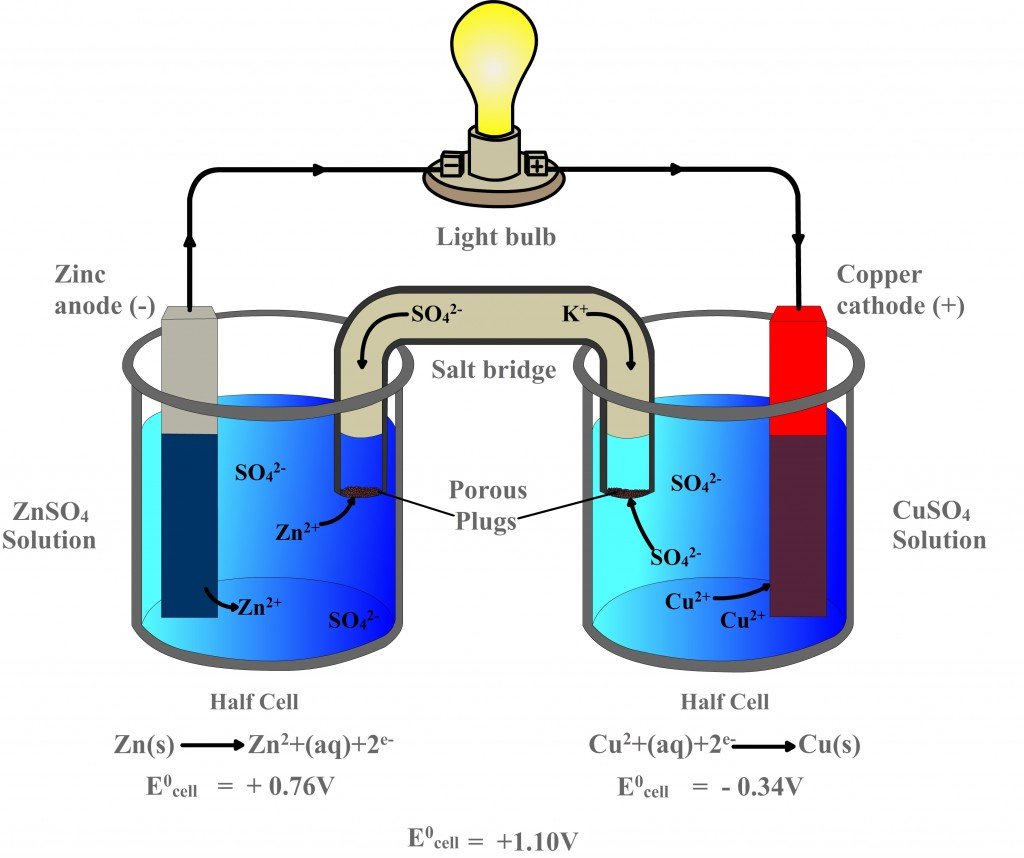
An electrochemical cell is a device that can work in two ways. It can produce electrical energy from chemical reactions, which happens in a galvanic or voltaic cell. Alternatively, it can use an external electrical source to drive chemical reactions, a process called electrolysis, in an electrolytic cell. Both types are made up of two half-cells, each handling either oxidation or reduction reactions separately. When multiple electrochemical cells are linked together in parallel or series, they create a battery. There are two main types of electrochemical cells: galvanic cells and electrolytic cells. A galvanic cell, also called a voltaic cell, is named after Luigi Galvani and Alessandro Volta. It generates electrical energy from spontaneous redox reactions. In this setup, a wire connects two different metals, such as zinc and copper. Each metal sits in its own solution, typically an aqueous sulfate or nitrate of that metal, though any metal salt and water that conducts electricity can be used. A salt bridge or porous membrane connects the two solutions, maintaining electrical neutrality and preventing charge buildup. The difference in the metals' oxidation and reduction potentials drives the reaction until equilibrium is reached. Key features of a galvanic cell include a spontaneous reaction, the generation of an electric current, current flowing through the wire while ions flow through the salt bridge, and the anode being negative while the cathode is positive. Each galvanic cell contains two half-cells. A half-cell consists of an electrode and an electrolyte. The chemical reactions involve the electrolyte, the electrodes, or an external substance—for example, fuel cells might use hydrogen gas as a reactant. In a full cell, one half-cell loses electrons (oxidation) to its electrode, while the other half-cell gains electrons (reduction) from its electrode. The salt bridge, often made of filter paper soaked in an electrolyte like KNO₃ or NaCl, connects the two half-cells ionically without letting their solutions mix, which prevents unwanted side reactions. Alternatively, the two half-cells can be allowed direct contact and mixing, as in simple water electrolysis. As electrons flow through the external circuit from one half-cell to the other, a charge difference builds up. Without ionic contact, this charge difference would stop the electron flow. The salt
- types
- Galvanic cell, electrolytic cell, primary cell, secondary cell, fuel cell
- key_components
- Electrodes, electrolyte, salt bridge or porous membrane
- voltage_range
- Roughly zero to 6 volts (water-based electrolytes limited to about 2.5 volts)
- common_examples
- Lead-acid battery, lithium cell, Bunsen cell
- applications
- Electrolysis, electroplating, portable power, automotive starting
Lore & Background
The galvanic cell, named after Luigi Galvani and Alessandro Volta, generates electrical energy from spontaneous redox reactions. A wire connects two different metals, each in a separate solution, with a salt bridge or porous membrane connecting the solutions to maintain electric neutrality. The metals' differences in oxidation/reduction potential drive the reaction until equilibrium is reached.
Reader's Guide
Electrochemical cells are fundamental to modern energy storage and conversion. Galvanic cells provide portable power through spontaneous reactions, while electrolytic cells enable industrial processes like water decomposition and electroplating via applied electrical energy. Primary cells, which use irreversible reactions, dominate the battery market but are environmentally problematic due to toxic heavy metals and acids. Secondary cells, with reversible reactions, are increasingly used in wireless devices and cordless tools. Fuel cells convert hydrogen and oxygen into electricity. The cell potential, predictable from standard electrode potentials, typically ranges up to 6 volts, with water-based electrolytes limiting voltages to about 2.5 volts due to water reactivity.
Did You Know?
- A salt bridge can be made from filter paper soaked in KNO3 or NaCl.
- The standard hydrogen electrode is assigned 0 volts for reference.
- About 15 billion primary batteries are thrown away worldwide every year.
- The energy needed to manufacture a battery is about 50 times greater than the energy it contains.
The Core Mechanism: How Electrochemical Reactions Differ from Ordinary Chemistry
Electrochemistry sits at the intersection of electrical potential and chemical transformation, a subfield of physical chemistry that traces how electrons travel through an electronically conducting phase—usually an external circuit, though not always, as electroless plating demonstrates—between two electrodes. These electrodes are separated by an electrolyte that conducts ions but blocks electrons, creating a necessary boundary. What sets an electrochemical reaction apart from an ordinary chemical reaction is the pathway of electron transfer: rather than electrons jumping directly from one atom, ion, or molecule to another, they are routed through that external conducting medium. When an applied voltage drives a chemical change, the process is called electrolysis; when a chemical reaction itself generates a voltage, as in a battery or fuel cell, the result is an electrochemical cell. The field also extends into the nanoscale, where the discipline is termed nanoelectrochemistry, applying the same fundamental principles to structures far smaller than conventional electrodes.
The Galvani-Volta Dispute and the Birth of the Field
The formal birth of electrochemistry is often traced to 1791, when Italian physician Luigi Galvani published his essay on the effect of electricity on muscular motion. Galvani observed that frog legs twitched when spanned by metal probes and concluded that animal tissue harbored an innate vital force he called "animal electricity," a form of electricity distinct from both natural sources like lightning and the electric eel, and artificial sources like static friction. His colleagues largely accepted this view, but Alessandro Volta pushed back, arguing the twitching resulted from differences in the metals' temper, composition, and bulk rather than any biological fluid. Galvani countered by showing muscular response even with two identical pieces of material. Despite never fully resolving the debate, Volta's relentless experimentation led him to exploit the relatively weak bonding of zinc to construct the first practical battery—a device capable of sustaining an electrical current far longer than any predecessor, and one that would become the essential tool for every subsequent breakthrough in the field.
Electrolysis, New Elements, and the Laws That Governed the Field
The early 1800s saw electrochemistry leap from curiosity to powerful analytical tool. In 1800, William Nicholson and Johann Wilhelm Ritter used Volta's battery to split water into hydrogen and oxygen, and Ritter soon discovered electroplating, noting that the quantity of deposited metal and evolved oxygen varied with electrode spacing. By the 1810s, William Hyde Wollaston refined the galvanic cell design. Sir Humphry Davy's electrolysis work proved that electricity in simple cells arose from chemical action between oppositely charged substances, a conclusion that directly enabled him to isolate metallic sodium and potassium from molten salts in 1808, along with the alkaline earth metals from their own molten compounds. In 1832, Michael Faraday articulated his two laws of electrochemistry, providing a quantitative framework. Then in 1836, John Daniell solved the persistent problem of polarization by introducing copper ions near the positive electrode to suppress hydrogen gas buildup, and later found that amalgamating zinc with mercury yielded a higher cell voltage.
From Fuel Cells to Everyday Batteries: The Road to Practical Power
The mid-to-late nineteenth century transformed electrochemical theory into devices people could actually use. In 1839, William Grove produced the first fuel cell, demonstrating that chemical energy could be continuously converted into electrical work. Georg Ohm, in his 1827 treatise on the galvanic circuit, had already provided the mathematical backbone for understanding current, voltage, and resistance in these systems. Thomas Johann Seebeck showed in 1821 that a temperature difference across the junction of two dissimilar metals generated an electrical potential, a thermoelectric effect that Ritter had anticipated just two decades earlier. On the battery front, Georges Leclanché patented a new cell design in 1868 that would evolve into the zinc-carbon cell, the world's first widely adopted battery. Wilhelm Weber's 1846 electrodynamometer gave researchers a precise instrument for measuring electrical forces. Together, these advances laid the groundwork for the portable power sources that would define the next two centuries of technology.
Gallery
Frequently Asked Questions
Who is Electrochemical cell?
An electrochemical cell is a device that converts chemical energy into electrical energy or the reverse, by splitting oxidation and reduction into two separate half-cells. It operates in two modes: as a galvanic (voltaic) cell that spontaneously generates electricity, or as an electrolytic cell that consumes external power to drive a chemical reaction.
What are Electrochemical cell's powers/role?
In galvanic mode it produces usable voltage from redox chemistry, while in electrolytic mode it forces non-spontaneous processes like electrolysis or electroplating. Each half-cell pairs an electrode with an electrolyte, and a salt bridge or porous membrane lets ions migrate between the two sides without mixing the solutions.
How does Electrochemical cell's story end?
When several cells are linked in series or parallel they become a battery, powering everything from portable electronics to automotive starting systems. In practice, water-based electrolytes limit output to roughly 2.5 volts, though the broader chemistry range extends to about six volts.
Why is Electrochemical cell important?
It is the foundational principle behind lead-acid car batteries, lithium cells, fuel cells, and industrial electroplating lines. Without the ability to isolate oxidation from reduction in two half-cells, modern portable power and a large share of manufacturing simply would not function.
What are Electrochemical cell's key components and types?
Every cell needs an anode, a cathode, an electrolyte medium, and a salt bridge or porous membrane to maintain ion flow. Depending on design and reusability, cells are classified as primary, secondary, galvanic, electrolytic, or fuel cells, with common real-world examples including the Bunsen cell and the lithium cell.
More in Electrochemistry And Surface Chemistry 1-18
Spotted an error? Know more?
This is a living reference — every entry is fact-audited, and reader corrections feed straight into our audit queue. Suggest an edit · See this site's audit record